


Become one of the very first trauma certified providers in the country and improve trauma patient outcomes with this two-day hands-on program! You will enhance your confidence, competence, and communication while managing emergent patients.
Why Attend?
You’ll Learn How To:
**PRE-REQUISITE MODULES MUST BE COMPLETED BEFORE
DECEMBER 3rd, 2026 FOR ELIGIBILITY**
Participants must complete the VetATLS certificate program ($375 for veterinarians & $225 for technician/nurses and other
vet staff) available through ACVECC (Online) Learning here.
VECCS Members receive a 20% discount for the online VetATLS certificate program. Please login to your member
dashboard to access the discount code.
The Details:
Dates: December 5 & 6, 2026
Open to: Veterinarians, Intern/Residents, Technician/Nurses, and Students
Location: VECCS Office – 23119 West IH-10, Building 13, San Antonio, TX 78257
Cost: VECCS Members Rate -$600 | Non-Members Rate – $650
Schedule:
8:00 AM – 9:00 AM All Things Blood
Objectives:
9:00 AM – 10:00 AM Peek and Poke
Objectives:
10:00 AM – 11:00 AM Airway/Breathing
Objectives:
11:00 AM – 12:00 PM Disability/Environment
Objectives:
12:00 PM – 1:00 PM Lunch (Included with your registration)
1:00 PM – 5:00 PM The Primary Survey – Scenario-Based Training
The Walk Phase bridges the isolated skills practiced during the Crawl Phase with their application in the context of a full trauma case. Teams talk through complete trauma scenarios step by step — primary survey, secondary survey, interventions, and disposition — without performing the hands-on procedures themselves. The emphasis shifts from technical skill to sequencing, prioritization, and team communication.
There are six Walk Phase scenarios, each focused on a different step of the primary survey (X, A, B, C, D, E). Each scenario is designed to last for about 10–15 minutes with a 10–15 minute debrief.
8:00 AM – 12:00 PM Putting It All Together – Scenario-Based Summative Assessments
The Run Phase is the full integration of the skills and decision-making practiced in the Crawl and Walk phases. Each team runs several complete trauma scenarios from start to finish, using mannequins and equipment from the Crawl Phase stations, under conditions that more closely resemble real-time clinical pressure.
Teams will go through three tested scenarios and a written test on the materials presented in the Provider Course and the online modules.
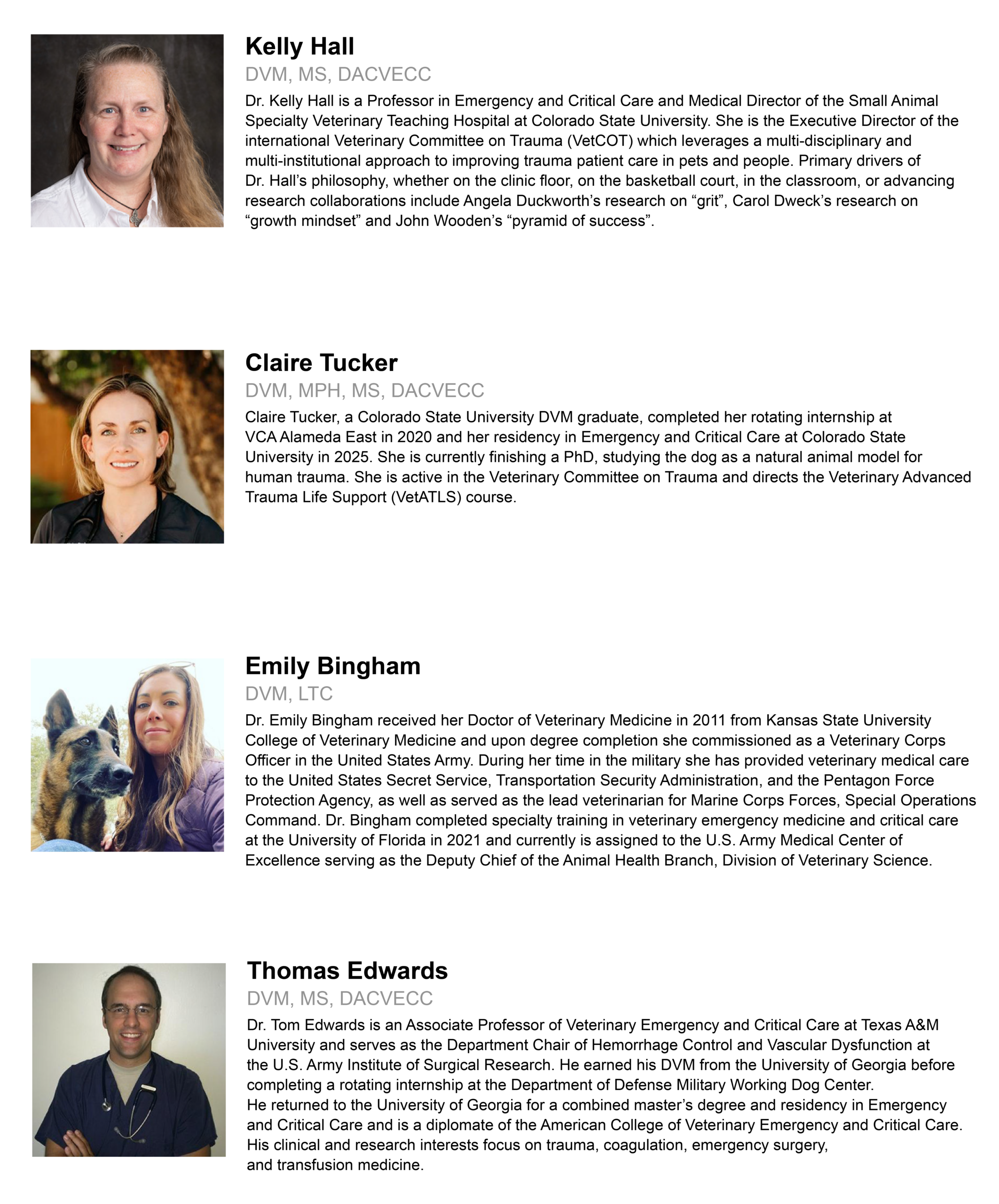
Instructors:
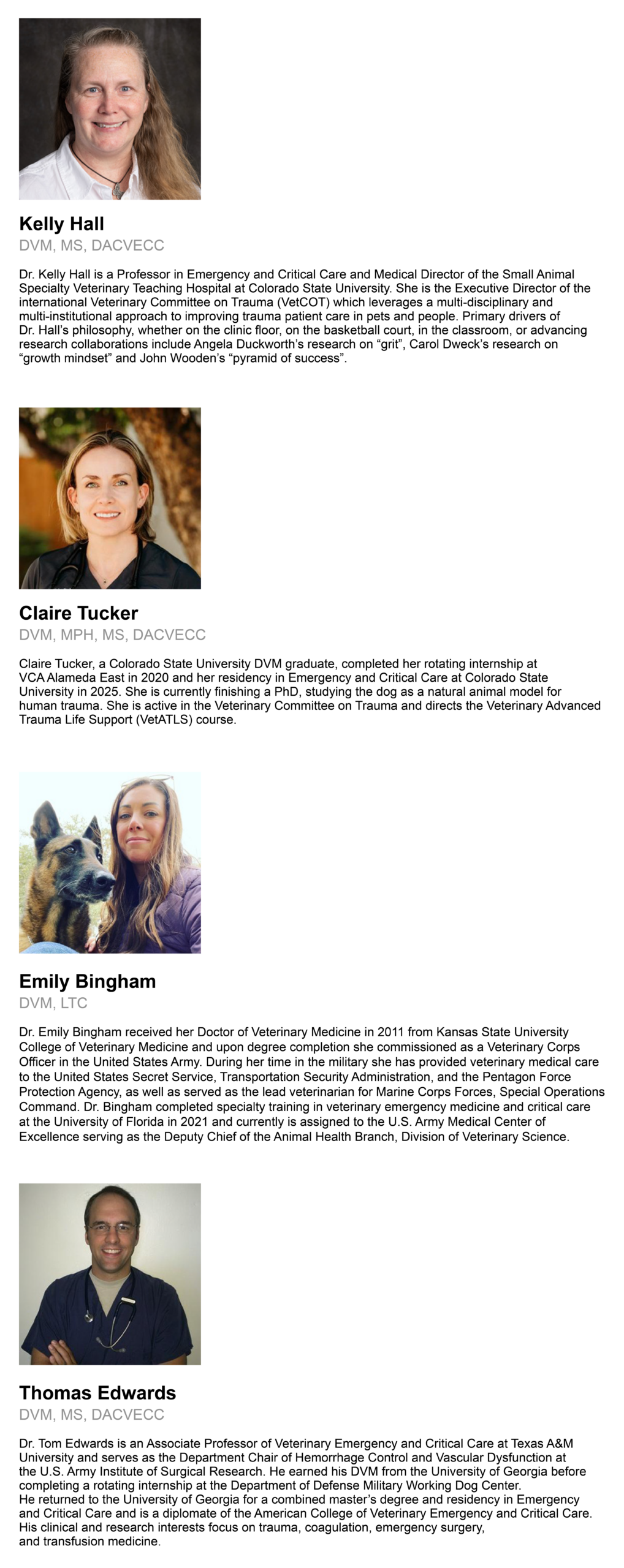
Become one of the very first trauma certified providers in the country and improve trauma patient outcomes with this two-day hands-on program! You will enhance your confidence, competence, and communication while managing emergent patients.
Why Attend?
You’ll Learn How To:
**PRE-REQUISITE MODULES MUST BE COMPLETED BEFORE
DECEMBER 3rd, 2026 FOR ELIGIBILITY**
Participants must complete the VetATLS certificate program ($375 for veterinarians & $225 for technician/nurses and other
vet staff) available through ACVECC (Online) Learning here.
VECCS Members receive a 20% discount for the online VetATLS certificate program. Please login to your member
dashboard to access the discount code.
The Details:
Dates: December 5 & 6, 2026
Open to: Veterinarians, Intern/Residents, Technician/Nurses, and Students
Location: VECCS Office – 23119 West IH-10, Building 13, San Antonio, TX 78257
Cost: VECCS Members Rate -$600 | Non-Members Rate – $650
Schedule:
8:00 AM – 9:00 AM All Things Blood
Objectives:
9:00 AM – 10:00 AM Peek and Poke
Objectives:
10:00 AM – 11:00 AM Airway/Breathing
Objectives:
11:00 AM – 12:00 PM Disability/Environment
Objectives:
12:00 PM – 1:00 PM Lunch (Included with your registration)
1:00 PM – 5:00 PM The Primary Survey – Scenario-Based Training
The Walk Phase bridges the isolated skills practiced during the Crawl Phase with their application in the context of a full trauma case. Teams talk through complete trauma scenarios step by step — primary survey, secondary survey, interventions, and disposition — without performing the hands-on procedures themselves. The emphasis shifts from technical skill to sequencing, prioritization, and team communication.
There are six Walk Phase scenarios, each focused on a different step of the primary survey (X, A, B, C, D, E). Each scenario is designed to last for about 10–15 minutes with a 10–15 minute debrief.
8:00 AM – 12:00 PM Putting It All Together – Scenario-Based Summative Assessments
The Run Phase is the full integration of the skills and decision-making practiced in the Crawl and Walk phases. Each team runs several complete trauma scenarios from start to finish, using mannequins and equipment from the Crawl Phase stations, under conditions that more closely resemble real-time clinical pressure.
Teams will go through three tested scenarios and a written test on the materials presented in the Provider Course and the online modules.
Instructors:
During this no-lecture, all-hands-on simulation lab, attendees will focus on identifying and treating the four common shock phenotypes. You will actively participate in a variety of exercises including managing patients in shock using high-fidelity simulators, hands-on procedural training using medium-fidelity simulators, and rounds-style discussions. Pre-lab preparatory materials will be provided to allow participants to prepare for the course ahead of time. In addition to using high-fidelity simulation to manage real patient scenarios, participants will practice life-saving procedures including thoracocentesis, chest tube placement, and advanced vascular access techniques on medium-fidelity training models.
The Details:
Dates: December 11th 8:00 AM – 5:15 PM | December 12th 8:00 AM – 12:45 PM
Location: VECCS Office – San Antonio, TX
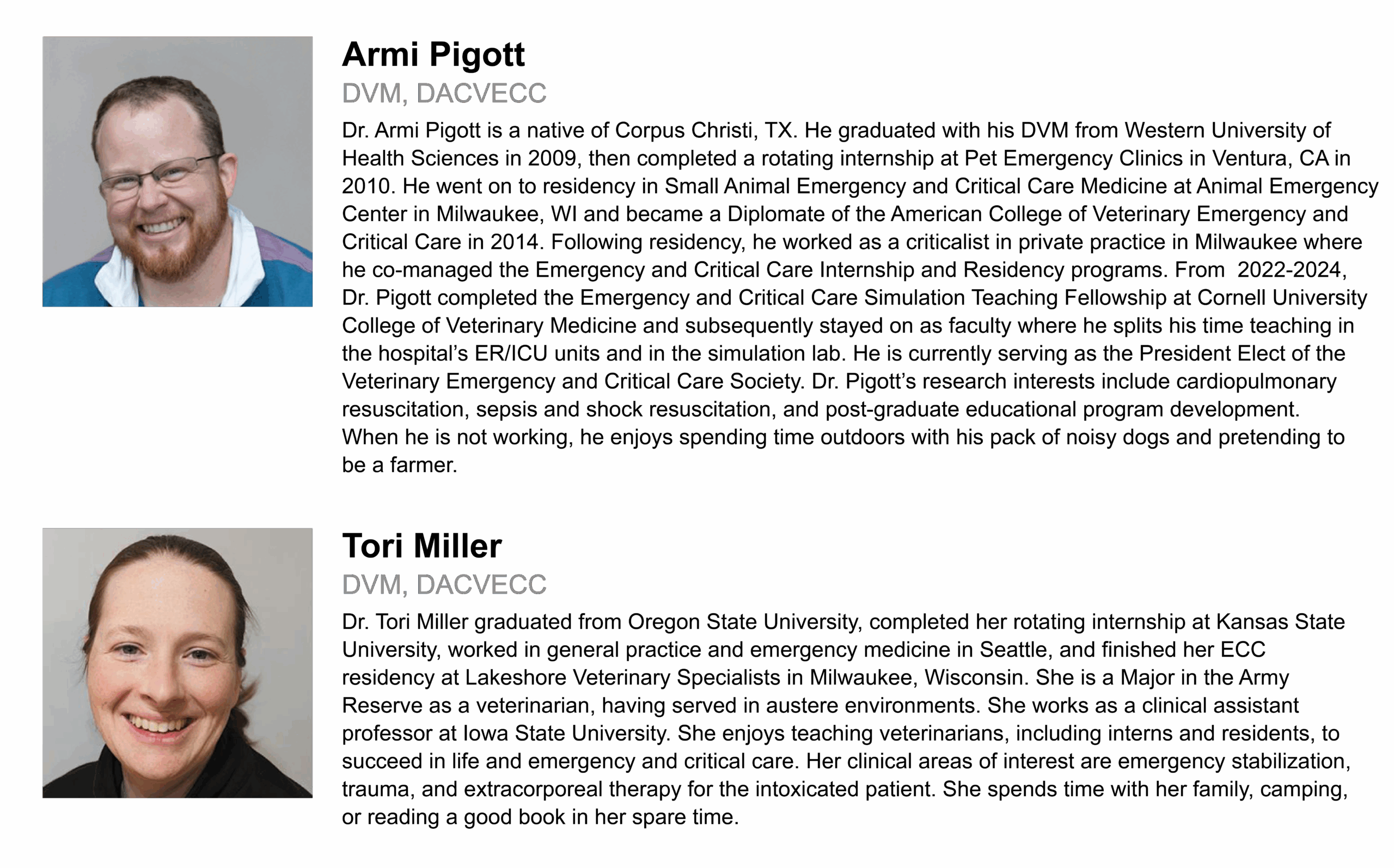
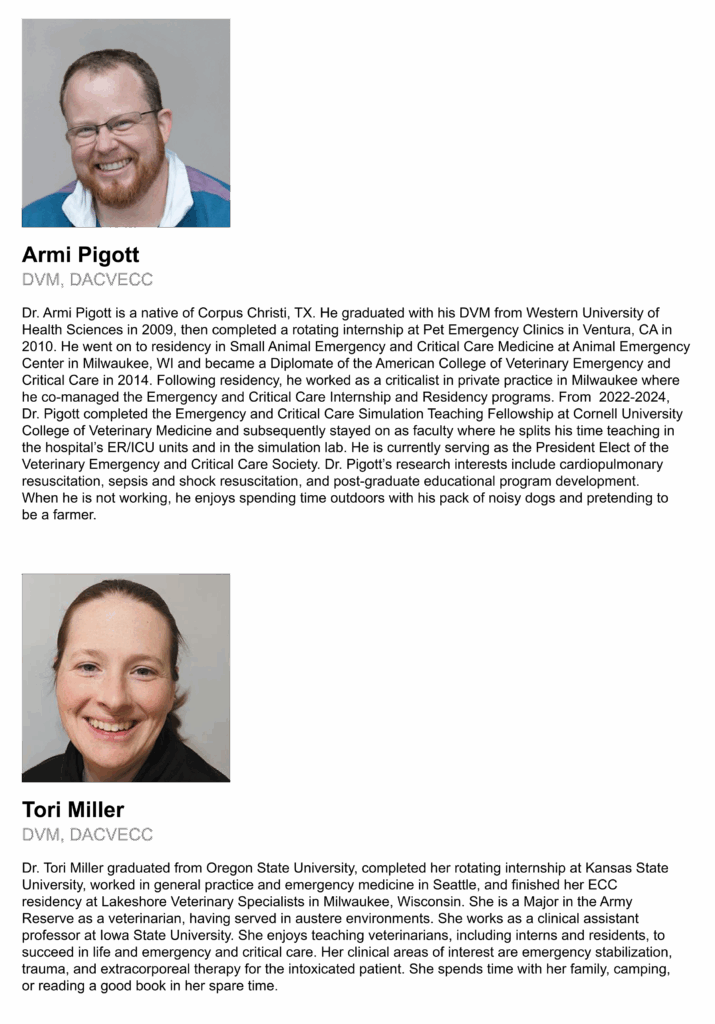
Instructors: Dr. Armi Pigott & Dr. Tori Miller
Cost: $650
CE Credits: Participants Receive 12.5 Medical CE Credits
Space limited to 16 VECCS Members!
Instructors:
During this no-lecture, all-hands-on simulation lab, attendees will focus on identifying and treating the four common shock phenotypes. You will actively participate in a variety of exercises including managing patients in shock using high-fidelity simulators, hands-on procedural training using medium-fidelity simulators, and rounds-style discussions. Pre-lab preparatory materials will be provided to allow participants to prepare for the course ahead of time. In addition to using high-fidelity simulation to manage real patient scenarios, participants will practice life-saving procedures including thoracocentesis, chest tube placement, and advanced vascular access techniques on medium-fidelity training models.
The Details:
Dates: December 11th 8:00 AM – 5:15 PM | December 12th 8:00 AM – 12:45 PM
Location: VECCS Office – San Antonio, TX
Instructors: Dr. Armi Pigott & Dr. Tori Miller
Cost: $650
CE Credits: Participants Receive 12.5 Medical CE Credits
Space limited to 16 VECCS Members!
Instructors:
This two-day lab offers veterinary professionals certification as RECOVER Certified BLS/ALS Instructors®. RECOVER Certified BLS/ALS Instructors® are approved to certify veterinary professionals as RECOVER Certified BLS/ALS Rescuers®. Participants will learn how to conduct the BLS and ALS Rescuer certification workshop and administer standardized assessments to certify others as RECOVER Certified BLS/ALS Rescuers®. Participants will learn how to run hands-on BLS certification workshops with CPR mannequins and how to certify learners in BLS. Attendees will then learn to run a hands-on ALS certification workshop with a canine patient simulator running a series of CPR simulations, and ultimately a final certification simulation.
The Details:
Dates: October 21 & 22, 2025
Open to: Licensed Veterinarians and Technicians
Location: VECCS Office – San Antonio, TX
Cost: Veterinarian – $1,100 | Technician/Intern/Resident – $900
Schedule:
8:00 AM – 12:00 PM Instructor Cert (4 CE Hours)
12:00 PM – 1:00 PM Lunch
1:00 PM – 5:00 PM Instructor Cert (4 CE Hours)
8:00 AM – 9:00 AM Set up and mannequin testing (1 CE Hour)
9:00 AM – 12:00 PM Rescuer Cert (3 CE Hours)
12:00 PM – 1:00 PM Lunch
1:00 PM – 4:00 PM Rescuer Cert (3 CE Hours)
4:00 PM – 5:00 PM Workshop Wrap Up (1 CE Hour)
CE Credits: 16 Medical CE Credits
Instructors:
This two-day lab offers veterinary professionals certification as RECOVER Certified BLS/ALS Instructors®. RECOVER Certified BLS/ALS Instructors® are approved to certify veterinary professionals as RECOVER Certified BLS/ALS Rescuers®. Participants will learn how to conduct the BLS and ALS Rescuer certification workshop and administer standardized assessments to certify others as RECOVER Certified BLS/ALS Rescuers®. Participants will learn how to run hands-on BLS certification workshops with CPR mannequins and how to certify learners in BLS. Attendees will then learn to run a hands-on ALS certification workshop with a canine patient simulator running a series of CPR simulations, and ultimately a final certification simulation.
The Details:
Dates: October 21 & 22, 2025
Open to: Licensed Veterinarians and Technicians
Location: VECCS Office – San Antonio, TX
Cost: Veterinarian – $1,100 | Technician/Intern/Resident – $900
Schedule:
8:00 AM – 12:00 PM Instructor Cert (4 CE Hours)
12:00 PM – 1:00 PM Lunch
1:00 PM – 5:00 PM Instructor Cert (4 CE Hours)
8:00 AM – 9:00 AM Set up and mannequin testing (1 CE Hour)
9:00 AM – 12:00 PM Rescuer Cert (3 CE Hours)
12:00 PM – 1:00 PM Lunch
1:00 PM – 4:00 PM Rescuer Cert (3 CE Hours)
4:00 PM – 5:00 PM Workshop Wrap Up (1 CE Hour)
CE Credits: 16 Medical CE Credits
Instructors:
How do we best treat animals in cardiopulmonary arrest? Evidence-based veterinary CPR guidelines published by the RECOVER Initiative aimed at maximizing patient survival after cardiopulmonary arrest led to the official veterinary CPR certification process approved by the American College of Veterinary Emergency and Critical Care (ACVECC). This course will teach RECOVER Basic Life Support (BLS) and Advanced Life Support (ALS) concepts and techniques. The certification process consists of an online course followed by the onsite training during this lab. Because of this, participants must have successfully completed the 2024 RECOVER CPR – BLS (Basic Life Support) and 2024 RECOVER CPR – ALS (Advanced Life Support) Course available at learning.acvecc.org. Successful completion of this workshop grants certification as a RECOVER Certified BLS/ALS Rescuer®. Human medical professionals are certified in human CPR. Veterinary medical professionals should certify themselves in veterinary CPR!
The Details:
Dates: October 22, 2025
Open to: Licensed Veterinarians and Technicians
Location: VECCS Office – San Antonio, TX
Veterinarian Cost: VECCS Members – $400 | Non-members – $450
Technician/Intern/Resident: VECCS Members – $350 | Non-members – $400
Student Cost: VECCS Members – $300 | Non-members – $350
Schedule:
9:00 AM – 12:00 PM Rescuer Cert (3 CE Hours)
12:00 PM – 1:00 PM Lunch
1:00 PM – 4:00 PM Rescuer Cert (3 CE Hours)
CE Credits: 6 Medical CE Credits
Instructors:
This interactive lab blends essential skills in veterinary neurology and ophthalmology to improve clinicians’ confidence in diagnosing and managing complex emergency cases. Through live animal exams, case-based discussions, and hands-on exercises, participants will refine their neurologic examination techniques, strengthen lesion localization skills, and review management of vestibular disease and acute seizures. The ophthalmology sessions focus on practical surgical and emergency procedures, including eyelid and orbital repairs, corneal and conjunctival techniques, and management of conditions such as proptosis, deep corneal ulcers, and glaucoma. A shared neuro-ophthalmology discussion will highlight the intersection of both specialties through real case examples and participant interaction.
The Details:
Dates: December 9th – December 10th
Location: VECCS Office – San Antonio, TX
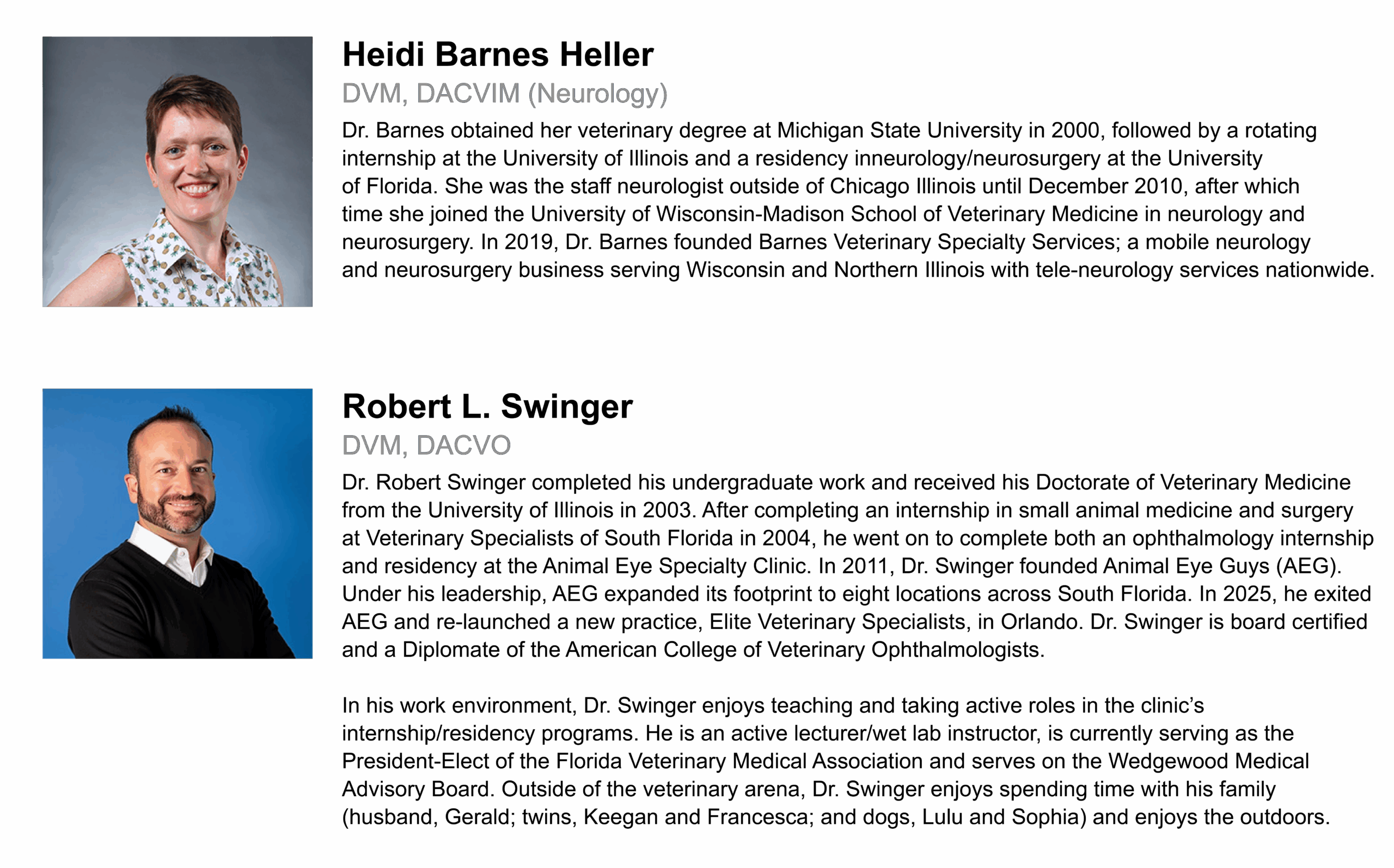
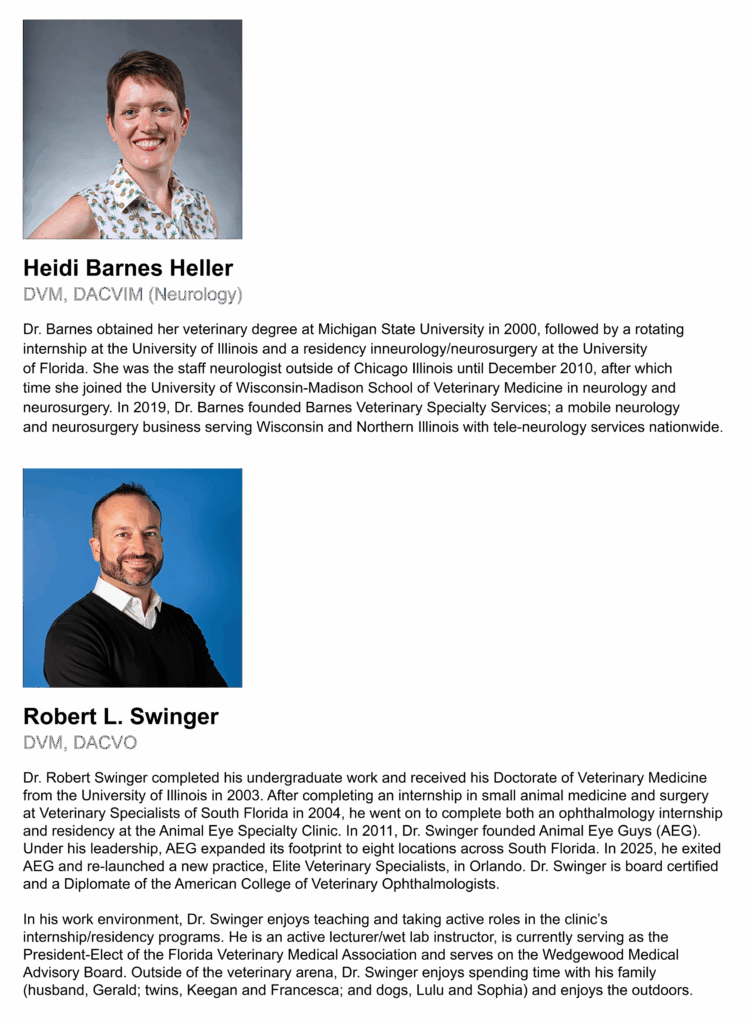
Instructors: Dr. Heidi Barnes Heller & Dr. Robert L. Swinger
Cost: $900
Schedule:
7:45 AM – 8:00 AM Registration
8:00 AM – 9:00 AM Understanding the Neurologic Examination in the Emergency Setting (Barnes Heller)
Interpretation of the neurologic examination is critical to successful lesion localization and lesion localization is critical to developing a differential list, and diagnostic plan. You don’t need to be a neurologist to be successful! Learn what to focus on in the emergency setting using a live animal exam.
9:00 AM – 10:00 AM Unmasking Vestibular Disease (Barnes Heller)
During this session, we will review the anatomy and normal function of the vestibular system, and apply this knowledge to a case based discussion of differential diagnosis, diagnostic testing, and treatment options for canine vestibular disease.
10:00 AM – 10:15 AM Break
10:15 AM – 12:15 PM You Get a Localization and YOU Get a Localization! “Getting” Neuroanatomic Lesion Localization Through Practice (Dry Lab) (Barnes Heller)
This hands-on interactive dry lab will focus on important aspects of neuroanatomic lesion localization through case based practice. Participants will be invited to move from station to station around the room to hone their skills.
12:15 PM – 1:00 PM Lunch (Provided By VECCS)
1:00 PM – 5:00 PM Ophthalmic Surgery and Procedures in Your Practice (Wet Lab) (Swinger)
Improve your proficiency in performing practical eyelid and orbital surgeries while gaining an appreciation for the skill level required for most corneal and conjunctival procedures. Receive step-by-step, video-driven instructions on how-to-do temporary tarsorrhaphies, temporary eyelid tacking, entropion correction, eyelid reconstruction, proptosis reduction, prolapsed gland of the nictitans replacement, corneal debridement techniques, nasolacrimal flushing, and enucleations.
8:00 AM – 9:00 AM Acute Seizure Management (Barnes Heller)
Acute seizure management requires rapid recognition of the event, and a thorough understanding of available anti-convulsant drugs. What do we “know” about the drugs we give? What routes are appropriate, and which are not? Using a case-based approach, we will explore these topics, and more while reviewing available literature surrounding acute seizure drugs.
9:00 AM – 11:00 AM Neuro-Ophthalmology Case Discussion (Barnes Heller and Swinger)
This will be a shared session between Drs. Swinger and Barnes Heller focusing on diseases that affect the eye. Bring your questions and any unusual cases you’ve encountered to this discussion time or join in the discussion about the cases presented.
11:00 AM – 11:15 AM Break
11:15 AM – 12:15 PM It’s All Fun and Games Until Someone Loses an EYE! An Overview of Ocular Emergencies. (Swinger)
One of the most challenging aspects of veterinary ophthalmology is dealing with emergencies. This includes how to perform emergency procedures, what drugs to have in your hospital for these cases, and how and when to refer to an ophthalmologist. This session will review common emergency management of cases, including melting/deep corneal ulcers, proptosed globes, hyphema, and acute glaucoma. This session will help you understand the long-term prognosis following these emergencies and what information needs to be relayed to owners as therapy is initiated.
12:15 PM – 12:30 PM Course Wrap-up
CE Credits: 12 Medical CE Credits
Instructors:
This interactive lab blends essential skills in veterinary neurology and ophthalmology to improve clinicians’ confidence in diagnosing and managing complex emergency cases. Through live animal exams, case-based discussions, and hands-on exercises, participants will refine their neurologic examination techniques, strengthen lesion localization skills, and review management of vestibular disease and acute seizures. The ophthalmology sessions focus on practical surgical and emergency procedures, including eyelid and orbital repairs, corneal and conjunctival techniques, and management of conditions such as proptosis, deep corneal ulcers, and glaucoma. A shared neuro-ophthalmology discussion will highlight the intersection of both specialties through real case examples and participant interaction.
The Details:
Dates: December 9th – December 10th
Location: VECCS Office – San Antonio, TX
Instructors: Dr. Heidi Barnes Heller & Dr. Robert L. Swinger
Cost: $900
Schedule:
7:45 AM – 8:00 AM Registration
8:00 AM – 9:00 AM Understanding the Neurologic Examination in the Emergency Setting (Barnes Heller)
Interpretation of the neurologic examination is critical to successful lesion localization and lesion localization is critical to developing a differential list, and diagnostic plan. You don’t need to be a neurologist to be successful! Learn what to focus on in the emergency setting using a live animal exam.
9:00 AM – 10:00 AM Unmasking Vestibular Disease (Barnes Heller)
During this session, we will review the anatomy and normal function of the vestibular system, and apply this knowledge to a case based discussion of differential diagnosis, diagnostic testing, and treatment options for canine vestibular disease.
10:00 AM – 10:15 AM Break
10:15 AM – 12:15 PM You Get a Localization and YOU Get a Localization! “Getting” Neuroanatomic Lesion Localization Through Practice (Dry Lab) (Barnes Heller)
This hands-on interactive dry lab will focus on important aspects of neuroanatomic lesion localization through case based practice. Participants will be invited to move from station to station around the room to hone their skills.
12:15 PM – 1:00 PM Lunch (Provided By VECCS)
1:00 PM – 5:00 PM Ophthalmic Surgery and Procedures in Your Practice (Wet Lab) (Swinger)
Improve your proficiency in performing practical eyelid and orbital surgeries while gaining an appreciation for the skill level required for most corneal and conjunctival procedures. Receive step-by-step, video-driven instructions on how-to-do temporary tarsorrhaphies, temporary eyelid tacking, entropion correction, eyelid reconstruction, proptosis reduction, prolapsed gland of the nictitans replacement, corneal debridement techniques, nasolacrimal flushing, and enucleations.
8:00 AM – 9:00 AM Acute Seizure Management (Barnes Heller)
Acute seizure management requires rapid recognition of the event, and a thorough understanding of available anti-convulsant drugs. What do we “know” about the drugs we give? What routes are appropriate, and which are not? Using a case-based approach, we will explore these topics, and more while reviewing available literature surrounding acute seizure drugs.
9:00 AM – 11:00 AM Neuro-Ophthalmology Case Discussion (Barnes Heller and Swinger)
This will be a shared session between Drs. Swinger and Barnes Heller focusing on diseases that affect the eye. Bring your questions and any unusual cases you’ve encountered to this discussion time or join in the discussion about the cases presented.
11:00 AM – 11:15 AM Break
11:15 AM – 12:15 PM It’s All Fun and Games Until Someone Loses an EYE! An Overview of Ocular Emergencies. (Swinger)
One of the most challenging aspects of veterinary ophthalmology is dealing with emergencies. This includes how to perform emergency procedures, what drugs to have in your hospital for these cases, and how and when to refer to an ophthalmologist. This session will review common emergency management of cases, including melting/deep corneal ulcers, proptosed globes, hyphema, and acute glaucoma. This session will help you understand the long-term prognosis following these emergencies and what information needs to be relayed to owners as therapy is initiated.
12:15 PM – 12:30 PM Course Wrap-up
CE Credits: 12 Medical CE Credits
Instructors:
This two-day session offers veterinary professionals certification as RECOVER Certified BLS/ALS Instructors®. RECOVER Certified BLS/ALS Instructors® are approved to certify veterinary professionals as RECOVER Certified BLS/ALS Rescuers®. Participants will learn how to conduct the BLS and ALS Rescuer certification workshop and administer standardized assessments to certify others as RECOVER Certified BLS/ALS Rescuers®. Participants will learn how to run hands-on BLS certification workshops with CPR mannequins and how to certify learners in BLS. Attendees will then learn to run a hands-on ALS certification workshop with a canine patient simulator, running a series of CPR simulations, and ultimately a final certification simulation.
PLEASE NOTE – To participate in this workshop, candidates must meet the following prerequisites on or before September 8th:
* VECCS Members will receive a 40% discount when purchasing RECOVER pre-requisites.
The Details:
Dates: October 23 & 24, 2026
Open to: VECCS Members ONLY – Licensed Veterinarians and Credentialed Technician/Nurses
Location: VECCS Office – 23119 West IH-10, Building 13, San Antonio, TX 78257
Cost: $1,400
Hotel & Transportation: When looking for accommodations, we recommend The Rim area of San Antonio, as it is near the VECCS Office and has many hotel and dining options. Click here for a Google Map search of the area.
Schedule:
8:00 AM – 12:00 PM Workshop
12:00 PM – 12:30 PM Lunch (included with your registration)
12:30 PM – 5:45 PM Workshop
8:00 AM – 9:00 AM Set up
9:00 AM – 12:30 PM Workshop (with Rescuers)
12:30 PM – 1:15 PM Lunch (included with your registration)
1:15 PM – 5:20 PM Workshop (with Rescuers)
5:20 PM – 6:30 PM Instructor Debrief and Wrap Up
Instructors:
This two-day session offers veterinary professionals certification as RECOVER Certified BLS/ALS Instructors®. RECOVER Certified BLS/ALS Instructors® are approved to certify veterinary professionals as RECOVER Certified BLS/ALS Rescuers®. Participants will learn how to conduct the BLS and ALS Rescuer certification workshop and administer standardized assessments to certify others as RECOVER Certified BLS/ALS Rescuers®. Participants will learn how to run hands-on BLS certification workshops with CPR mannequins and how to certify learners in BLS. Attendees will then learn to run a hands-on ALS certification workshop with a canine patient simulator, running a series of CPR simulations, and ultimately a final certification simulation.
PLEASE NOTE – To participate in this workshop, candidates must meet the following prerequisites on or before September 8th:
* VECCS Members will receive a 40% discount when purchasing RECOVER pre-requisites.
The Details:
Dates: October 23 & 24, 2026
Open to: VECCS Members ONLY – Licensed Veterinarians and Credentialed Technician/Nurses
Location: VECCS Office – 23119 West IH-10, Building 13, San Antonio, TX 78257
Cost: $1400
Hotel & Transportation: When looking for accommodations, we recommend The Rim area of San Antonio, as it is near the VECCS Office and has many hotel and dining options. Click here for a Google Map search of the area.
Schedule:
8:00 AM – 12:00 PM Workshop
12:00 PM – 12:30 PM Lunch (included with your registration)
12:30 PM – 5:45 PM Workshop
8:00 AM – 9:00 AM Set up
9:00 AM – 12:30 PM Workshop (with Rescuers)
12:30 PM – 1:15 PM Lunch (included with your registration)
1:15 PM – 5:20 PM Workshop (with Rescuers)
5:20 PM – 6:30 PM Instructor Debrief and Wrap Up
Instructors:
How do we best treat animals in cardiopulmonary arrest? Evidence-based veterinary CPR guidelines published by the RECOVER Initiative aim at maximizing patient survival after cardiopulmonary arrest. This course will teach RECOVER Basic Life Support (BLS) and Advanced Life Support (ALS) concepts and techniques.
The certification process consists of an online course followed by onsite training at the workshop. Because of this, participants must have successfully completed the RECOVER CPR – BLS (Basic Life Support) and RECOVER CPR – ALS (Advanced Life Support) Course available at RECOVER Academy. Successful completion of this workshop grants certification as a RECOVER Certified BLS/ALS Rescuer®. Human medical professionals are certified in human CPR. Veterinary medical professionals should certify themselves in veterinary CPR!
PLEASE NOTE – To participate in this workshop, candidates must meet the following prerequisites on or before October 12th:
*VECCS Members will receive a 40% discount and Non-Members will receive a 20% discount when purchasing RECOVER pre-requisites.
The Details:
Dates: October 24, 2026
Open to: Veterinarians, Technicians/Nurses, and Students
Location: VECCS Office – 23119 West IH-10, Building 13, San Antonio, TX 78257
Hotel & Transportation: When looking for accommodations, we recommend The Rim area of San Antonio, as it is near the VECCS Office and has many hotel and dining options. Click here for a Google Map search of the area.
Cost: VECCS Members Rate -$250 | Non-Members Rate – $350
*Non-Member Registration Opens, August 13th
Schedule:
9:00 AM – 12:30 PM Workshop
12:30 PM – 1:15 PM Lunch (included with your registration)
1:15 PM – 5:20 PM Workshop
Instructors:
How do we best treat animals in cardiopulmonary arrest? Evidence-based veterinary CPR guidelines published by the RECOVER Initiative aim at maximizing patient survival after cardiopulmonary arrest. This course will teach RECOVER Basic Life Support (BLS) and Advanced Life Support (ALS) concepts and techniques.
The certification process consists of an online course followed by onsite training at the workshop. Because of this, participants must have successfully completed the RECOVER CPR – BLS (Basic Life Support) and RECOVER CPR – ALS (Advanced Life Support) Course available at RECOVER Academy. Successful completion of this workshop grants certification as a RECOVER Certified BLS/ALS Rescuer®. Human medical professionals are certified in human CPR. Veterinary medical professionals should certify themselves in veterinary CPR!
PLEASE NOTE – To participate in this workshop, candidates must meet the following prerequisites on or before October 12th:
*VECCS Members will receive a 40% discount and Non-Members will receive a 20% discount when purchasing RECOVER pre-requisites.
The Details:
Dates: October 24, 2026
Open to: Veterinarians, Technicians/Nurses, and Students
Location: VECCS Office – 23119 West IH-10, Building 13, San Antonio, TX 78257
Hotel & Transportation: When looking for accommodations, we recommend The Rim area of San Antonio, as it is near the VECCS Office and has many hotel and dining options. Click here for a Google Map search of the area.
Cost: VECCS Members – $250 | Non-Members – $350
*Non-Member Registration Opens, August 13th
Schedule:
9:00 AM – 12:30 PM Workshop
12:30 PM – 1:15 PM Lunch (included with your registration)
1:15 PM – 5:20 PM Workshop
Instructors:
To provide the best experience on our site, we use cookies and similar technologies to store and/or access device information. Consenting allows us to process data such as browsing behavior. Not consenting may affect certain features and functions.
To provide the best experience on our site, we use cookies and similar technologies to store and/or access device information. Consenting allows us to process data such as browsing behavior. Not consenting may affect certain features and functions.